MagSafe has become an important feature in the phone case market.
For brands developing a new MagSafe-compatible case, one specification often appears in supplier discussions:
N52 magnet.
But is N52 enough to guarantee good magnetic performance?
Not necessarily.
The magnet grade is only one part of the equation. The actual performance of a MagSafe case also depends on magnet dimensions, thickness, magnetization, magnetic array design, positioning, distance from the phone, case construction and the final magnetic force of the assembled product.
This is why professional MagSafe case development should go beyond checking the magnet grade on a material specification sheet.
1. N52 Is a Magnet Grade, Not a Guarantee of Final Performance
N52 is a grade of NdFeB permanent magnet material. It describes the magnetic material’s performance level under specified conditions.
But two magnets both labeled N52 can still produce different results in an actual phone case.
Why?
Because the final magnetic performance is affected by factors such as:
- Magnet size and thickness
- Magnetization quality
- Magnet positioning
- Magnetic polarity and array design
- Distance between the magnet and the phone
- Case wall thickness
- Adhesive or structural layers
- Manufacturing tolerances
So simply asking a supplier:
Are you using N52 magnets?
is not enough.
The more useful question is:
What magnetic performance does the completed case achieve?
This distinction becomes particularly important when developing products for established consumer electronics brands.
2. Gauss Testing Gives You One Important Piece of Information
One test we use during MagSafe case development is measuring the magnetic field using a Gauss meter.
The purpose is not simply to obtain a large number.
The measurement helps us understand whether the magnets are generating the expected magnetic field at the specified measurement position.
But the test result must always be interpreted together with the test method.
For example, the measured Gauss value can change depending on:
- Measurement position
- Distance from the magnet
- Magnet geometry
- Magnet orientation
- Magnetic array structure
This means that two suppliers reporting different Gauss values may not necessarily be measuring under the same conditions.
For meaningful supplier comparison, the test method and measurement position should be standardized, not just the number.
Apple’s accessory design guidelines also specify magnetic field requirements at defined positions, illustrating why measurement conditions matter rather than relying on a generic Gauss number.
3. Pull Force Testing Is Even Closer to the Real User Experience
Gauss testing tells us about the magnetic field.
But customers ultimately care about something different:
How strongly does the finished case hold the accessory?
That’s why pull-force testing is another important part of our QC process.
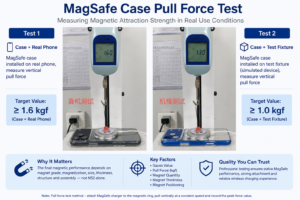
A typical test can be performed by:
- Installing the case on the phone.
- Attaching a MagSafe charger to the magnetic ring.
- Connecting a force gauge.
- Pulling vertically at a controlled and consistent speed.
- Recording the peak pull-force value.
We can also compare the results under different conditions, such as:
Case + phone
versus
Case + test fixture
This gives a much more practical picture of the final product’s magnetic performance.
Apple’s published accessory guidelines provide an example of this type of system-level requirement, specifying magnetic force ranges for cases with and without the device.
4. The Number of Magnets Also Matters
Another simple but important inspection point is the magnet quantity.
The internal magnet configuration should match the approved golden sample.
For production inspection, this can mean:
Disassembling samples when necessary to verify the internal magnet quantity and arrangement.
Why does this matter?
Because the outside of a finished phone case may look exactly the same even when the internal magnetic configuration is different.
A supplier may change:
- Magnet quantity
- Magnet size
- Magnet thickness
- Magnet position
- Magnetic material
without creating an obvious visual difference.
But the magnetic performance can change significantly.
For this reason, internal construction should be treated as part of the product specification, not merely a manufacturing detail.
5. Magnet Thickness Can Make a Big Difference
Another issue that is easily overlooked is magnet thickness.
A magnet can have a high material grade, but if its physical dimensions or magnetic configuration are not appropriate for the application, the final magnetic force may still be disappointing.
This is particularly important for slim phone cases.
There is always a design trade-off between:
Magnetic performance
and
overall case thickness.
The magnet needs to generate sufficient magnetic force while remaining properly integrated into the case structure.
The distance between the magnet and the phone/accessory also matters.
This is why MagSafe performance should be evaluated on the finished case, not only on the loose magnet before assembly.
6. A Good MagSafe Test Should Follow the Product, Not Just the Material
For a professional MagSafe case project, we recommend looking at several layers of verification:
Material level
Magnet grade
Magnet dimensions
Magnet quantity
Magnetization
Component level
Gauss measurement
Magnetic polarity
Magnet ring positioning
Finished product level
Case + test fixture pull force
Case + real phone pull force
MagSafe charging test
Accessory compatibility
This is a much more reliable approach than simply checking whether the supplier wrote N52 on the material specification.
The Real Problem With Low-Cost MagSafe Cases
The problem is not that every low-cost magnet is necessarily bad.
The problem is that a low-cost specification can look identical on paper while the final product performs differently.
For a supplier competing mainly on price, it can be tempting to focus on:
N52 magnet
MagSafe compatible
Strong magnetic attraction
But without a defined testing method, these statements don’t tell the brand buyer enough.
A professional buyer should ask:
What is the magnetic field measurement?
Where was it measured?
What is the pull force of the finished case?
How was the pull force measured?
Was it tested with a real device?
Does the internal magnet configuration match the approved sample?
These questions are much more valuable than simply asking whether the magnet is N52.
What We Recommend for Brand Buyers
If you’re developing a new MagSafe phone case, we recommend defining the magnetic requirements before mass production, not after complaints appear in the market.
At minimum, the supplier and brand should agree on:
- Magnet grade
- Magnet dimensions
- Magnet quantity
- Magnet arrangement
- Gauss testing method
- Pull-force testing method
- Test fixture
- Real-device testing
- Acceptance criteria
- Golden sample
Most importantly, the acceptance criteria should be agreed before production starts.
That prevents a common problem:
The supplier says the product is qualified.
The buyer says the magnetic force is too weak.
Both sides then start arguing about whose standard is correct.
The better solution is simple:
Define the test method before production.
Final Thought
A MagSafe phone case may look like a simple plastic product.
But the magnetic system inside it is an engineering component.
The magnet grade is important.
But it is only the beginning.
N52 does not automatically mean good MagSafe performance.
What matters is how the magnetic system performs after it becomes part of the finished product.
At Sendtin Case, we believe that the invisible parts of a product deserve the same attention as the visible ones.
Because sometimes the biggest quality problem is the one the customer cannot see.
And magnetic performance is one of them.