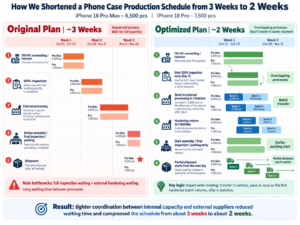
For a new iPhone launch, one week can make a real difference.
We recently received an urgent production request covering two iPhone 18 models: approximately 6,500 pcs for iPhone 18 Pro Max and 7,500 pcs for iPhone 18 Pro.
The customer wanted the products on the market as quickly as possible to catch the new-phone sales window.
When I reviewed the first production schedule, the normal process required close to three weeks.
The customer wanted two.
The question was not simply:
“Can production work faster?”
The more useful question was:
“Where are we actually losing time?”
The Original Plan: Every Process Waited for the Full Lot
Let’s use the 6,500 pcs iPhone 18 Pro Max order as an example.
The original production flow was straightforward:
PC injection → TPU+PC overmolding → 100% inspection → external hardening and secondary processing → button assembly → final inspection → packing → shipment
Original Plan
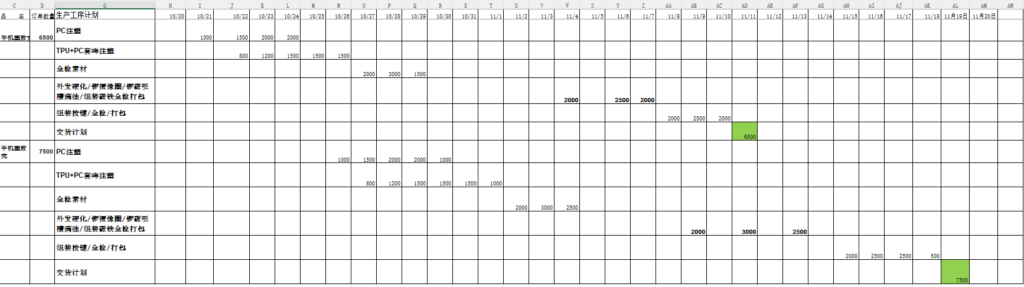
There was nothing wrong with any individual process.
The problem was the way they were scheduled.
Under the original plan, the full quantity of TPU+PC overmolded cases would be completed first.
Only after all 6,500 pcs were molded would the inspection team start the 100% inspection.
That inspection itself required several days.
After all parts were inspected, the entire lot would then be sent out for external processing, including hardening and related secondary operations.
Only after the full quantity returned would button assembly, final inspection and packing begin.
And finally, all 6,500 pcs would be shipped together.
In other words:
Finish everything → inspect everything → send everything out → wait for everything back → pack everything → ship everything.
The biggest problem was not processing time.
It was waiting time between processes.
Change 1: Start Inspection Before Molding Is Finished
The first opportunity was the 100% inspection stage.
There was no reason to wait until all 6,500 pcs had completed TPU+PC overmolding.
By the third day of overmolding, roughly 3,000 pcs of molded parts were already available.
So we coordinated internal inspection capacity and started checking the earlier production immediately.
The molding line kept running.
At the same time, QC started the 100% inspection on the parts already completed.
This changed the flow from:
Finish molding → Start inspection
to:
Keep molding + Start inspecting the completed quantity at the same time
By the time the overmolding process was finished, a large portion of the parts had already been inspected.
The remaining quantity was completed shortly afterwards.
We did not reduce the inspection requirement.
Every part still went through 100% inspection.
We simply stopped allowing finished molded parts to sit and wait.
Change 2: Do Not Wait for All 6,500 pcs Before External Processing
The next bottleneck was external hardening and secondary processing.
Under the original plan, the supplier would receive the full lot only after all inspection was completed.
That created another unnecessary queue.
Instead, we split the material flow into two batches.
Once the first batch of nearly 3,000 inspected cases was ready, it was released to the external supplier immediately.
The remaining quantity stayed in the factory and continued through inspection.
When the second batch was finished, it followed.
So while:
Batch 1 was already undergoing external processing,
Batch 2 was still being inspected.
Again, no process was removed.
We simply allowed the next process to start earlier.
This is an important difference in production planning.
If every department waits for the entire order quantity, the schedule becomes long very quickly.
If a stable batch can move forward safely, the whole project starts flowing.
Change 3: Start Packing as Soon as the First Batch Returns
We applied the same logic after external processing.
There was no need to wait for both batches to return before starting assembly and packing.
When the first hardened batch came back to the factory, we immediately arranged the next steps:
button assembly → final inspection → packing
At that point, the second batch could still be at the external supplier.
The first batch was already moving again.
By the third day after the returned material started coming in, around 3,500 pcs were already available for the packing line.
The packing team then worked through the finished quantity over several days.
The key was that we did not wait for all 6,500 pcs to be packed before thinking about shipment.
Change 4: Ship Finished Goods in Batches
The original plan called for one shipment after the entire order was complete.
We changed that as well.
Once finished goods started coming off the packing line, the available quantity was prepared for shipment.
The next day, the first completed batch could already leave.
The remaining goods continued through assembly, final inspection and packing.
Then the next batch followed.
So the final flow became:
Mold some → inspect some → send some out → receive some back → pack some → ship some
while the remaining quantity continued moving through the earlier stages.
This was very different from waiting for all 6,500 pcs at every step.
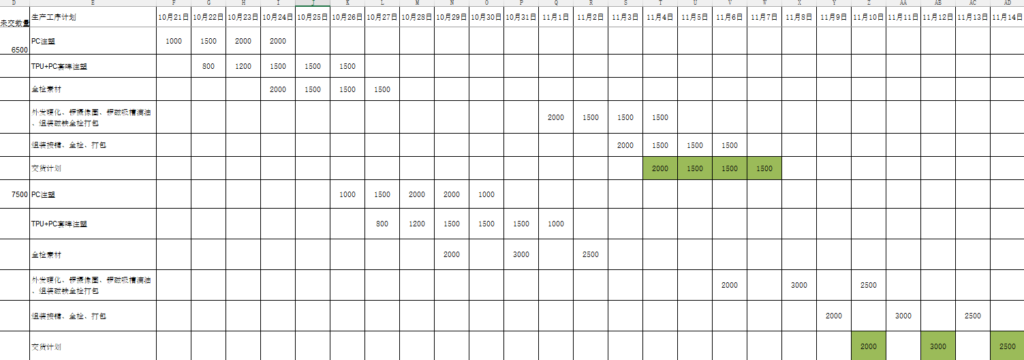
The Real Improvement Was in the Handover Between Processes
Looking at the two schedules side by side, the biggest improvement did not come from making one machine run dramatically faster.
It came from tightening the connection between each process.
We coordinated:
- Injection molding capacity
- 100% inspection capacity
- External supplier pickup and return timing
- Assembly and packing capacity
- Partial shipment arrangements
The material was kept moving instead of sitting between departments.
That allowed several processes to overlap safely.
The result was that a production schedule that originally required nearly three weeks could be compressed to around two weeks.
We Did Not Shorten the Quality Process
This is the part I consider most important.
When a customer asks for an earlier delivery date, shortening the schedule should not mean:
- skipping inspection,
- reducing necessary processing,
- or pushing unfinished parts into the next stage.
In this project, the 100% inspection remained.
The external processing remained.
Final inspection remained.
The difference was that we reduced the time spent waiting for the full lot.
A good production planner should always ask:
Does the next process really need to wait for 100% of the order?
Sometimes the answer is yes.
But very often, a stable first batch can already move forward.
That is where several days can be recovered.
Sometimes One Week Is Hidden Between Processes
For me, this project was a good example of what production planning really means.
A schedule is not only a list of dates.
It is a flow of materials, people, internal capacity and external suppliers.
When one step finishes, the next step should be ready to receive it.
When enough material is available to move safely, it should move.
For fast-moving consumer-electronics products, especially around a new iPhone launch, that coordination can directly affect how quickly a customer gets product into the market.
We did not shorten the quality process.
We shortened the waiting between processes.
And sometimes, that is where an entire week is hiding.